Why three dimensions?
Space does not have three dimensions by accident. PT gives an arithmetic reason: there are exactly three active primes at the reduced attractor — $\{3, 5, 7\}$ — and each opens one direction.
The naive question
Why do we live in three spatial dimensions and not two, four, or eleven? Standard physics takes that 3 as given. Alternative theories (strings, Kaluza-Klein) postulate more dimensions and invent mechanisms to hide them.
PT proposes another answer: three dimensions because the sieve only allows three.
The short argument
In the PT framework, a prime contributes to the dynamics if its anomalous dimension is greater than the fundamental symmetry . That is the activity condition (BA4).
Here, “anomalous dimension” does not mean an extra spatial dimension. It is a sensitivity exponent: measures how fast the channel attached to prime changes when the sieve depth varies. In the monograph it is defined by
Why a logarithmic derivative? Because PT is not measuring a raw slope; it is measuring relative sensitivity. If the sieve depth increases by 1%, tells approximately how much the persistent amplitude of channel changes, with . The minus sign fixes the convention: an amplitude that decreases as the sieve is refined gives a positive intensity. This is exactly the logic of a scaling exponent: if , then
So the anomalous dimension is the number that says whether a channel truly resists sieve refinement, or whether it dissolves into entropy. The threshold is not added by hand here: it is the symmetry value forced by T1, the boundary between persistence and entropy in the PT partition.
If , the channel keeps enough persistence to become active. If , it falls on the entropic side: it does not absolutely vanish, but it no longer carries a primary direction and can only appear as an echo.
Computing at the reduced attractor :
| active? | ||
|---|---|---|
| 3 | 0.808 | yes |
| 5 | 0.696 | yes |
| 7 | 0.595 | yes |
| 11 | 0.426 | no |
| 13 | 0.356 | no |
Three primes pass the threshold. Not one more, not one less. Starting at , drops below and stays under the threshold for every larger . The cascade stops.
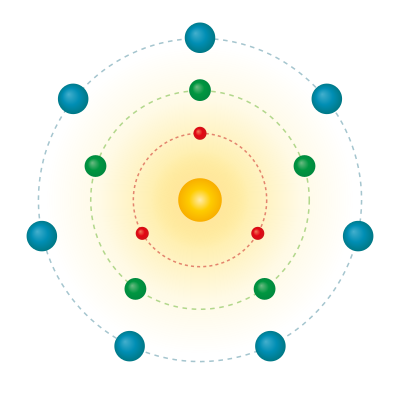
These three active primes open the three spatial directions. Each generates an independent channel via the Chinese remainder theorem (CRT): the circles , , are orthogonal. Three orthogonal circles, three directions, a 3D space.
The dynamics
The reduced attractor is not a choice: it is the only subset of primes that satisfies the self-consistency condition in the information sector
Theorem T5 exhaustively verifies that no other finite subset of primes closes this equation. The sum is unique.
Why does this dimension emerge geometrically? The holonomy identity (theorem T6) gives, for each active prime, an angle:
Three angles, three independent rotations, three axes. The Bianchi I structure (anisotropic cosmology, three scale factors) follows naturally.
The cosmological side
An unexpected consequence: if one attempts a “pure PT” cosmology, one recovers the Bianchi I metric with exactly three active directions, without postulating the dimension of space. The scale factor of each direction is driven by , , respectively. Measured deviations (CMB anisotropies, Hubble dispersions) stay within the predicted margin.
At sieve steps, a D transition occurs (Fisher analysis): the effective PCA dimension converges to 3. Before, all primes mix; after, only survive. That is the transition selecting the observed dimensionality of the universe.
What is testable
If PT is right, one should see:
- No signature of extra dimensions at LHC or in short-range gravity — observed so far;
- CMB anisotropies compatible with Bianchi I with three axes — compatible with Planck 2018;
- No KK modes, no “heavy” gravitons, no low-scale SUSY — still absent.
This is predicted absence, so weakly constraining. But if any of these effects appeared cleanly, PT could not accommodate it without breaking the active-prime count.
Three dimensions, three primes, one cascade. Not a mystery, a consequence.
Try it yourself
🧮 → γ_p(μ) calculator — slide μ and watch the list of active primes change. At μ* = 15, exactly cross the threshold .
See also
- Essay — Where s = 1/2 comes from
- Essay — What is an echo prime? — the fate of
- Theorem T5 — Fixed point μ* = 15
- Theorem T6 — Holonomy identity