Glossary
Glossary
Technical terms specific to Persistence Theory. These terms also appear as hover popovers in essays and articles — try mousing over them.
For the full glossary (116 entries: authors, acronyms, mathematics), see the monograph’s Glossary chapter.
Epistemic tag: derivation. Result derived from the PT chain, testable against experiment. Stronger than [PRED], weaker than [THM].
Epistemic tag: algebraic identity. True with no physical assumption (e.g. GFT: log m = D_KL + H). Maximum epistemic strength, equivalent to [THM].
Epistemic tag: falsifiable prediction. Numerical statement not yet verified but imposed by PT. E.g. δ_CP(PMNS) = 197.4° (DUNE ~2032).
Epistemic tag: PT theorem. Result proved unconditionally inside the mathematical PT framework. Highest epistemic level in PT.
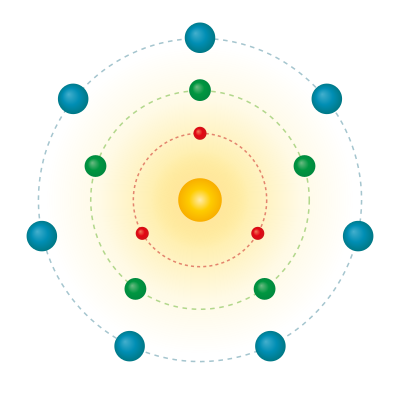
Prime p with γ_p > s = 1/2 at the fixed point μ*. Three active primes: {3, 5, 7}. All primes ≥ 11 are inactive, but may appear as echoes. Determines N_gen = N_c = 3.
Logarithmic sensitivity exponent γ_p = −d ln(sin²θ_p)/d ln μ. It measures how fast the cyclic phase of a prime p changes as the sieve level μ varies. The criterion γ_p > s selects active primes.
Architectural Principle 7. log_2(m) = D_KL + H is an IDENTITY: one cannot add energy already counted in D_KL. The q⁺/q⁻ bifurcation is an orthogonal partition, not a duplication.
Fifth bridge axiom. Derived theorem: α_EM is the Pontryagin product of sin²(θ_p) over active primes. Not a postulate — a consequence.
C_F = 4/3, fundamental Casimir factor of SU(N_c) with N_c = 3. In PT, derived from the T_3 matrix (7/9 allowed transitions) and the equation (3·N_c+1)(N_c-3)=0. Appears in QCD string tension, proton mass, η/η'.
Chinese Remainder Theorem. Z/(p·q·r)Z ≅ Z/pZ × Z/qZ × Z/rZ for distinct primes. Source of the orthogonality of the three circles {3, 5, 7} and 3D dimensionality.
Kullback–Leibler divergence. In PT, measures the persistence of a distribution P relative to uniform U_m. Measured in bits. This is what literally persists.
Inactive prime (γ_p < s). It does not contribute as a dynamical primary, but may leave an echo polarization that dresses couplings. {11, 13} are the dominant echo primes.
Coupling dressing by echo primes {11, 13}. β_echo = Σ sin²(θ_p)·γ_p ≈ 0.1039. Plays in PT the role of QED renormalisation counter-terms, without virtual particles: it is the persistent trace of channels that fell below the γ_p > 1/2 threshold. Pushes 1/α_EM from 14 ppb to 0.01 ppb away from CODATA.
Inactive information fraction of the sieve up to N primes: F_echo(N) = 1 − 2/(e^γ · ln N). At N = 10¹⁰: 95.12 % vs ΛCDM 95.07 % (0.06 % gap). PT's 'informational dark matter' — non-particulate, structurally carried by echo primes.
Binary informational leakage. F(2) ≈ 0.7583. Dresses α_bare = 1/136.28 to α_EM = 1/137.036 (leading order). Originates from the p = 2 channel (info/anti-info boundary).
Exact derivation of the Koide coefficient from s = 1/2: C_K = G_Fisher/sin²θ_3 + (1 + 5δ_3²/18)/21 = 4/sin²θ_3 + (1 + 5δ_3²/18)/21 = 18.300 (0.04 ppm). Each active prime contributes to a single order: p₁=3 (tree, spin Fisher info), p₃=7 (NLO, cross-channel skip), p₂=5 (NNLO, central refinement).
Parseval characterisation of the Q = 2/3 condition on ℤ/3ℤ: Q_Koide = 2/3 ⟺ |a₁|/|a₀| = 1/√2 = √s, where a₀, a₁ are the discrete Fourier coefficients of (√m_e, √m_μ, √m_τ). The AC/DC ratio of the leptonic mass spectrum equals the square root of the fundamental spin. Promoted from COND to THM in April 2026.
Effective coupling for fluctuations: G_Fisher/cos²(θ_3) = 4/0.781 = 5.12. Resummation of all perturbation orders on channel p = 3. Appears in the Fisher-Koide identity. See Architectural Principle 6.
Gap Fundamental Theorem. Algebraic identity log₂(m) = D_KL(P ‖ U_m) + H(P). It is the fundamental principle of persistence: informational capacity is conserved and decomposes exactly into persistence and entropy.
Mechanism by which D_KL converts into a physical observable: projection onto the sieve reference frame (Ry for chemistry, m_e for particle physics). Encoded by cos²(θ_p) on the holonomy angles. See Architectural Principle 5.
Mathematical name for phase transport around the circle ℤ/pℤ. **Canonical PT translation** (monograph): “cyclic phase”. Intuitive reading: it is the memory trace the sieve retains as a prime channel p is traversed — the angle θ_p measures how much the persistent structure has rotated after a full cycle. Cyclic Phase Identity: cos θ_p = 1 − δ_p, hence sin²(θ_p) = δ_p(2 − δ_p).
Maximum entropy lemma. The geometric distribution is the unique memoryless max-entropy distribution on ℕ. No choice: forced.
Number of fermion generations. In PT: N_gen = |{active primes}| = |{3, 5, 7}| = 3. Equal to N_c (quark colors) — not a coincidence.
Theorem: for every p ≥ 3, M_p = T_p^T·T_p is a Gram matrix (hence PSD). For m = p₁·...·p_k, M_m = ⊗ M_p. Consequence: Osterwalder-Schrader applies to every finite T_m, producing a Wightman QFT. Promoted VAL → THM.
Structured part of a distribution, measured in bits by D_KL. Conserved along the PT cascade. Per-channel cap = 1 bit (sin²θ_p ≤ 1).
Definition: Q = (√m_e + √m_μ + √m_τ)² / (m_e + m_μ + m_τ). Experimentally measured to 2/3 = (N_c−1)/N_c. **Why 2/3?** See the Fourier-Koide lemma [PROVEN], which gives the algebraic characterisation of this value via Parseval on ℤ/3ℤ. **What is C_K?** See the Fisher-Koide identity that derives the coefficient C_K = 18.300 from s = 1/2.
**Vertex / coupling** branch: q⁺ = 1 − 2/μ. At μ* = 15, q⁺ = 13/15. **Forced route**: maximum entropy (L0) on the geometric distribution over even integers {2, 4, 6, …}. The mean-μ constraint uniquely fixes q = 1 − 2/μ — not a choice. **Once fixed, the branch operates simultaneously on the discrete side (ℤ/pℤ circles via CRT) and the continuous side (angles θ_p)**. Gives sin²(θ_p, q⁺) → α_EM, lepton masses, PMNS. **q⁺ cannot be obtained via a continuous route**: the continuum limit of a geometric on even integers is an exponential, which gives q⁻ = e^(−1/μ).
Primitive split seeded by the p = 2 involution, frozen at μ* = 15 into two **roles**: q⁺ (vertex / coupling) and q⁻ (edge / propagator). **Common pitfall**: the bifurcation does not split the “discrete” from the “continuous”. Both branches operate simultaneously on discrete objects (ℤ/pℤ circles, three active directions {3, 5, 7}) and continuous ones (holonomy angles θ_p, Fisher metric). The discrete/continuous axis only characterises the initial **derivation routes**: L0 exact max-entropy → q⁺; Boltzmann limit → q⁻. **What truly separates the branches** is their physical role (interaction at a point vs propagation between points), hence leptons/PMNS on one side, quarks/CKM/gravity on the other. Latent heat L = q⁻ − q⁺ ≈ 0.069 → cosmological dark sector.
**Edge / propagator / geometry** branch: q⁻ = e^(−1/μ). At μ* = 15, q⁻ = e^(−1/15). **Forced route**: Boltzmann (Gibbs) limit for a continuous exponential distribution on ℝ⁺ of mean μ. The constraint uniquely fixes q = e^(−1/μ) — not a choice. **Once fixed, the branch operates simultaneously on the continuous side (Fisher metric of Bianchi I) and the discrete side (the three active directions {3, 5, 7})**. Gives sin²(θ_p, q⁻) → quark masses, CKM mixing, gravitational metric. **q⁻ cannot be obtained via a discrete route**: discretising a continuous exponential yields a geometric, which gives q⁺ = 1 − 2/μ. q⁻ and q⁺ are the two regimes of the same variational problem; q⁻ = lim(continuum) q⁺.
Derived fundamental symmetry of the sieve. Every other dimensionless constant descends from it together with the arithmetic structure. It is forced by mod-3 forbidden transitions (T1), rather than chosen as a free parameter.
Algebraic holonomy identity (T6): sin²(θ_p) = δ_p (2 − δ_p). Trigonometry emerges naturally from transport around the circle Z/pZ.
Self-consistent re-perturbation of the primary cascade by F(2). Δ* = F(2) / (1 + γ_3·r·Π) with |ρ| ≈ 8×10⁻⁴ (contraction). Truncation error O(ρ²) ≈ 6×10⁻⁷. This spiral is what pushes 1/α_EM into the sub-ppb regime.
Dynamical Field Theorem. Under conditions U1–U4, the gap sequence {g_n} is the unique admissible dynamical field of the sieve; BA0 is therefore forced.
Forbidden Transitions theorem. At mod-3 sieve level, transitions 1→1 and 2→2 are forbidden; this zero diagonal forces the symmetry s = 1/2.
Arithmetic torus T³ = Z/(3·5·7)Z = Z/105Z. Unified gauge space of the three active channels. Physical amplitudes factor on it via CRT.
Informational attractor theorem. μ* = 15 is the unique stable closure of Σ p_active = μ with γ_p(μ) > s in the reduced sector without dynamical p=2. Verified exhaustively by exact rational arithmetic.
Holonomy theorem. sin²(θ_p) = δ_p(2 − δ_p) is exact (not approximate). Identified to 3.5 × 10⁻⁷ bits with the Gibbs measure on all tested moduli.
Fine-structure constant. In PT: α_EM = ∏ sin²(θ_p, q⁺) over {3, 5, 7} = 1/136.28, dressed by F(2) to 1/137.036 (CODATA). Zero fitted parameters.
β_echo {11,13}: universal, IR (roles I+II), enters α_EM dressing. β_super-echo(μ) {11,13,17,19,23}: scale-dependent, hadronic (role III), covers 88 % of the P'_5 tension in FCNCs.
Anomalous dimension of prime p at the fixed point: γ_p = −d ln(sin²θ_p) / d ln μ. A prime is active if γ_p > s = 1/2. At μ* = 15: γ_3 = 0.808, γ_5 = 0.696, γ_7 = 0.595, γ_11 = 0.426 (inactive).
Gap fraction for prime p: δ_p = (1 − qᵖ) / p. Elementary building block of holonomy (T6).
Physical attractor of the reduced information sector: μ* = 3 + 5 + 7 = 15. After p=2 crystallises into binary infrastructure, no other finite prime subset closes the reduced-sector self-consistency equation.