Quantum gravity
From sieve to ringdown
PT does not only try to quantize Einstein. It proposes that Einstein geometry is the gravitational reading of a continuous wave mechanics whose persistent points are selected by the sieve.
Fisher / holonomy → CRT → constraints → amplitudes → Kerr
Plain language
Do not quantize the scenery, read the scenery from the quantum
The usual difficulty of quantum gravity often comes from an overly rigid image: on one side continuous spacetime, on the other a discrete quantum world. One then tries either to cut the continuum into small bricks or to make the continuum emerge from a collection of bricks.
PT proposes a different order. First there is a continuous information mechanics: phases, holonomies, Fisher metric, proper time. The sieve does not replace that wave; it marks the places where it becomes persistent, like stable nodes or resonances.
A simple image: a vibrating string carries a continuous wave, but some points become privileged because they remain stable. PT quantum gravity reads spacetime in that way: the continuum carries the wave, the sieve selects remarkable points.
This changes the question. Instead of asking “how do we quantize the metric?”, PT asks “why does this continuous mechanics select precisely these channels, constraints, and amplitudes?”.
Black-hole ringdown then becomes a natural test: after a merger, the black hole rings like an instrument. If PT channels are real, some phases of that sound should follow Kerr selection.
Wave
The continuous side carries phases, metric, and holonomies: it is not a mesh to refine.
Nodes
The sieve marks channels that persist within this continuous mechanics.
Test
Kerr ringdowns test phase selection and the dissipative channel.
Standard
Physical architecture: continuous, remarkable points, covariance
The classical sector comes from informational geometry: the distribution family of the sieve carries a Fisher metric gᶠ, then the active restriction gives Fisher-Bianchi geometry, Lorentzian signature, and Einstein equations.
The minimal quantum sector adds dynamics: transfer matrices Tₘ define the CRT Hilbert space, canonical constraints select persistent states, and boundary amplitudes give the covariant version of the calculation.
The decisive conceptual point is the dissolution of the “continuum limit”. PT does not start from a geometric mesh whose spacing must go to zero; it starts from a continuous mechanics whose persistent points are marked by the sieve.
For black holes, ringdown becomes a selection observable. Kerr phase follows a spin half-holonomy; the dissipative dτ channel still has to be finely validated on real signals.
Fisher wave → CRT points → Hilbert → constraints → Kerr
Standard
Continuous wave and persistent points
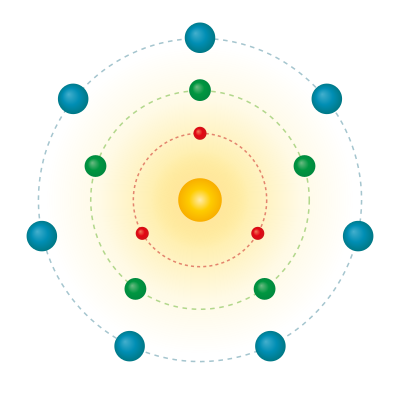
The diagram is deliberately conceptual: it shows that PT does not replace the continuum with a grid. Fisher/holonomy mechanics remains continuous; the sieve selects persistent points, channels, and closures.
This distinction matters pedagogically. The discrete is not spacetime dust; it is the trace of resonances surviving the constraint.
Covariance then comes from how boundary amplitudes glue: the calculation must give the same physical content independently of the chosen slicing.
Native continuum
Fisher, phases, and holonomies form the wave-like support of the dynamics.
Selection
Tₘ and CRT isolate persistent channels without making spacetime out of bricks.
Covariance
Constraints, amplitudes, and foams ensure that slicing does not change the result.
Technical
Complete technical demonstration
The technical level unfolds the chain without shortcuts: continuous Fisher/holonomy mechanics, selection of persistent points by the sieve, CRT Hilbert space, GR sector, constraints, covariant amplitudes, foams, then Kerr observables.
The continuous support is gᶠ with its associated phases and holonomies. It is defined on the distribution family and directly gives informational geometry.
Discrete selection is carried by Tₘ. By CRT, it marks remarkable points of this continuous mechanics, factorizes into primes, and supplies a tensor structure.
Fisher
gᶠ measures sensitivity of persistent distributions.
holonomies
Cyclic phases give transport channels.
Tₘ
The transfer matrix removes self-copying and marks survivors.
CRT
Prime factorisation supplies local tensor structure.
Hilbert
The inductive limit preserves persistent selections.
constraints
Canonical constraints remove boundary redundancies.
amplitudes
Covariant amplitudes glue on arbitrary boundaries.
Kerr
Spin half-holonomy selects the ringdown phase correction.
DER/VAL
The minimal sector is coherent as a structurally tested derived chain.
OPEN
The dissipative dτ channel must still be isolated cleanly in real ringdowns.
Caution
PT does not claim full experimental validation of quantum gravity here.
Status
Epistemic status
The QG sector is a strong structural reconstruction but empirically more open than already stabilised observables. Kerr tests and the dissipative channel must remain presented as a validation programme.