1
Choose the shell
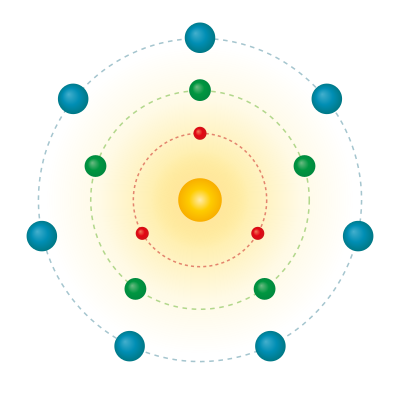
The active shell gives the number of available channel positions.
PT chemistry / capture boundary
Electron affinity EA is the energy released when a neutral atom captures an electron. In PT, this capture is read as an entry at the edge of a discrete channel.
Short version: PT does not ask only whether a place is open. It asks where the next place sits, and in which geometry it opens.
The active shell has capacity $N = 2(2ell+1)$ and contains $n$ electrons. The added electron is read on the receiver edge $x=(n+1)/N$, then PT threshold, core, channel, and contact-depth fields correct the capture energy.
MAE over 73 positive atomic electron affinities.
The score compares the PT value to the experimental reference as a mean relative error. The table excludes zero or negative EAs, which belong to a separate classification test.
Status: physical derivation plus numerical validation. The statement "EA reads the capture boundary" remains bridge language, not an unconditional mathematical theorem.
EA tells us whether an atom welcomes an extra electron. PT gives a simple picture: the added electron must find a stable entry point on the edge of the shell. Halogens are very good at this; some metals have a much more fragile entry.
The active shell gives the number of available channel positions.
The added electron enters through the next receiver position.
Depth and closures adjust the released energy.
In this drawing, green positions are already occupied. The orange line connects the last occupied position to the next capture position. This edge position is what the PT engine turns into an energy. The more naturally the edge closes the channel, the stronger capture tends to be.
Electron affinities control anion formation, halogen strength, charge transfer, and the reactivity of many families. A single geometric reading that follows metals, p blocks, and d/f blocks is therefore a demanding test.
| Element | PT EA | Ref. | Error |
|---|---|---|---|
| H | 0.749 | 0.754 | -4.98 meV |
| C | 1.246 | 1.262 | -16.33 meV |
| O | 1.464 | 1.461 | +2.52 meV |
| Cl | 3.617 | 3.613 | +4.25 meV |
| Mo | 0.770 | 0.748 | +21.79 meV |
This level keeps the chemical vocabulary and numerical quantities: PT value, experimental reference, signed error, and channel position. The percentages below are the MAE after each model layer, from the geometric reading to the contact-depth correction.
polygonal capture/ejection reading
the active channel fixes N = 2(2ℓ+1)
surface transmission
the capture boundary is weighted by exp[-ℓ(ℓ−1)]
p closures and compact d polarization
the first threshold residuals become fixed fields
channel harmonics
d, f, and p are read on x = (n+1)/N
radial hierarchy
τ = period − 4 replaces discrete d-block gates
Pick a positive reference. The calculator shows the canonical value, the experimental residual, and the channel reading.
n is the occupation already present, N is the active-channel capacity, and x=(n+1)/N is the position reached after capture.
Values in eV; signed error is PT − reference. Zero or negative EAs are not listed here.
| Z | Element | Block | n/N | PT EA | Reference | Error meV | Error % |
|---|---|---|---|---|---|---|---|
| 1 | H | s | 1/2 | 0.749 | 0.754 | -4.98 | -0.660 |
| 3 | Li | s | 1/2 | 0.628 | 0.618 | +10.45 | +1.690 |
| 5 | B | p | 1/6 | 0.277 | 0.277 | +0.25 | +0.091 |
| 6 | C | p | 2/6 | 1.246 | 1.262 | -16.33 | -1.294 |
| 8 | O | p | 4/6 | 1.464 | 1.461 | +2.52 | +0.173 |
| 9 | F | p | 5/6 | 3.426 | 3.401 | +25.10 | +0.738 |
| 11 | Na | s | 1/2 | 0.544 | 0.548 | -4.30 | -0.785 |
| 13 | Al | p | 1/6 | 0.425 | 0.433 | -8.50 | -1.962 |
| 14 | Si | p | 2/6 | 1.369 | 1.385 | -15.79 | -1.140 |
| 15 | P | p | 3/6 | 0.760 | 0.746 | +14.05 | +1.884 |
| 16 | S | p | 4/6 | 2.058 | 2.077 | -18.88 | -0.909 |
| 17 | Cl | p | 5/6 | 3.617 | 3.613 | +4.25 | +0.118 |
| 19 | K | s | 1/2 | 0.494 | 0.502 | -7.87 | -1.567 |
| 20 | Ca | s | 2/2 | 0.025 | 0.025 | +0.04 | +0.148 |
| 21 | Sc | d | 1/10 | 0.183 | 0.188 | -4.61 | -2.450 |
| 22 | Ti | d | 2/10 | 0.078 | 0.079 | -0.85 | -1.083 |
| 23 | V | d | 3/10 | 0.513 | 0.526 | -12.94 | -2.459 |
| 24 | Cr | d | 5/10 | 0.665 | 0.666 | -0.84 | -0.126 |
| 26 | Fe | d | 6/10 | 0.153 | 0.151 | +2.19 | +1.454 |
| 27 | Co | d | 7/10 | 0.656 | 0.661 | -4.55 | -0.689 |
| 28 | Ni | d | 8/10 | 1.135 | 1.156 | -21.30 | -1.843 |
| 29 | Cu | d | 10/10 | 1.217 | 1.228 | -10.85 | -0.884 |
| 31 | Ga | p | 1/6 | 0.427 | 0.430 | -3.15 | -0.733 |
| 32 | Ge | p | 2/6 | 1.236 | 1.233 | +3.15 | +0.256 |
| 33 | As | p | 3/6 | 0.792 | 0.804 | -11.64 | -1.447 |
| 34 | Se | p | 4/6 | 2.023 | 2.021 | +1.93 | +0.096 |
| 35 | Br | p | 5/6 | 3.385 | 3.365 | +20.06 | +0.596 |
| 37 | Rb | s | 1/2 | 0.490 | 0.486 | +3.77 | +0.776 |
| 38 | Sr | s | 2/2 | 0.051 | 0.052 | -1.01 | -1.940 |
| 39 | Y | d | 1/10 | 0.314 | 0.307 | +6.61 | +2.154 |
| 40 | Zr | d | 2/10 | 0.431 | 0.426 | +5.25 | +1.234 |
| 41 | Nb | d | 4/10 | 0.871 | 0.893 | -21.91 | -2.454 |
| 42 | Mo | d | 5/10 | 0.770 | 0.748 | +21.79 | +2.914 |
| 43 | Tc | d | 5/10 | 0.541 | 0.550 | -9.26 | -1.684 |
| 44 | Ru | d | 7/10 | 1.041 | 1.050 | -8.77 | -0.835 |
| 45 | Rh | d | 8/10 | 1.139 | 1.137 | +2.12 | +0.186 |
| 46 | Pd | d | 10/10 | 0.557 | 0.557 | +0.14 | +0.025 |
| 47 | Ag | d | 10/10 | 1.302 | 1.302 | -0.26 | -0.020 |
| 49 | In | p | 1/6 | 0.409 | 0.404 | +5.50 | +1.361 |
| 50 | Sn | p | 2/6 | 1.109 | 1.112 | -2.93 | -0.264 |
| 51 | Sb | p | 3/6 | 1.051 | 1.047 | +3.75 | +0.359 |
| 52 | Te | p | 4/6 | 1.969 | 1.971 | -1.76 | -0.089 |
| 53 | I | p | 5/6 | 3.099 | 3.059 | +39.90 | +1.304 |
| 55 | Cs | s | 1/2 | 0.470 | 0.472 | -1.66 | -0.351 |
| 56 | Ba | s | 2/2 | 0.147 | 0.145 | +2.08 | +1.433 |
| 57 | La | d | 0/10 | 0.479 | 0.470 | +9.44 | +2.009 |
| 58 | Ce | f | 2/14 | 0.653 | 0.650 | +2.61 | +0.401 |
| 59 | Pr | f | 3/14 | 0.994 | 0.962 | +32.03 | +3.330 |
| 60 | Nd | f | 4/14 | 1.900 | 1.916 | -15.94 | -0.832 |
| 61 | Pm | f | 5/14 | 0.128 | 0.129 | -1.28 | -0.994 |
| 62 | Sm | f | 6/14 | 0.162 | 0.162 | +0.24 | +0.147 |
| 63 | Eu | f | 7/14 | 0.858 | 0.864 | -6.50 | -0.752 |
| 64 | Gd | f | 8/14 | 0.134 | 0.131 | +3.04 | +2.319 |
| 65 | Tb | f | 9/14 | 1.167 | 1.165 | +2.18 | +0.187 |
| 66 | Dy | f | 10/14 | 0.353 | 0.352 | +0.85 | +0.242 |
| 67 | Ho | f | 11/14 | 0.335 | 0.338 | -2.73 | -0.807 |
| 68 | Er | f | 12/14 | 0.311 | 0.312 | -1.33 | -0.427 |
| 69 | Tm | f | 13/14 | 1.033 | 1.029 | +3.95 | +0.384 |
| 70 | Yb | f | 14/14 | 0.019 | 0.020 | -0.71 | -3.535 |
| 71 | Lu | d | 1/10 | 0.344 | 0.346 | -1.62 | -0.469 |
| 72 | Hf | d | 2/10 | 0.178 | 0.178 | +0.22 | +0.125 |
| 73 | Ta | d | 3/10 | 0.331 | 0.322 | +8.86 | +2.751 |
| 74 | W | d | 4/10 | 0.814 | 0.815 | -1.46 | -0.179 |
| 75 | Re | d | 5/10 | 0.146 | 0.150 | -3.61 | -2.409 |
| 76 | Os | d | 6/10 | 1.094 | 1.078 | +16.09 | +1.493 |
| 77 | Ir | d | 7/10 | 1.563 | 1.565 | -2.06 | -0.132 |
| 78 | Pt | d | 9/10 | 2.135 | 2.128 | +7.12 | +0.334 |
| 79 | Au | d | 10/10 | 2.309 | 2.309 | -0.49 | -0.021 |
| 81 | Tl | p | 1/6 | 0.380 | 0.377 | +2.62 | +0.695 |
| 82 | Pb | p | 2/6 | 0.364 | 0.364 | +0.02 | +0.006 |
| 83 | Bi | p | 3/6 | 0.946 | 0.946 | -0.25 | -0.026 |
| 84 | Po | p | 4/6 | 1.899 | 1.900 | -0.57 | -0.030 |
| 85 | At | p | 5/6 | 2.413 | 2.416 | -3.06 | -0.127 |
The technical level exposes the action formula, constants, harmonics, and remaining residuals. The result is a physical bridge validation, with its domain of validity made explicit.
The calculation starts from a geometric value $EA_{\rm geo}$, then multiplies it by a correction exponential:
These terms use fixed PT constants; they are not adjusted on the EA benchmark.
Important point: the periodic table supplies discrete samples (element, block, period), but the calculation is not a list of cases. Once the channel is selected, the corrections are evaluated by continuous functions of the capture position x, the depth τ, and the relativistic scale Zα.
| Layer | Amplitude | Role | Support |
|---|---|---|---|
| p threshold | −δ₃δ₅ | fine p closure | p4/p5 edges |
| d core | sδ₅ | compact d polarization | weighted by Z²α² |
| d continuous | −δ₅² | pentagon harmonic | sin(2πx) |
| f leakage | −CROSS₃₇ | f entry/closure | incoming edge minus outgoing edge |
| p center | +CROSS₅₇ | p central pressure | before double d closure |
| d depth | S₃δ₃, S₃δ₅, δ₅², CROSS₅₇ | radial Kd kernel | L₀..L₃ basis on τ |
The channel names the shape occupied by the captured electron: s, p, d, or f. Radial depth names the same channel when it appears lower in the periodic table. A period-4 d electron and a period-6 d electron therefore live in the same polygonal channel, but not at the same depth.
Sc, Ti, Zr, and Hf all belong to the d channel: capacity 10, same polygonal logic.
The period tells how far radially the channel is realized: 4d, 5d, 6d, 7d.
PT writes this depth as τ = period − 4. Former period effects become points on one curve, not separate exceptions.
The L₀..L₃ basis then acts as the reading rule: at each realized depth, it selects the matching sample of the continuous kernel. This discrete/continuous passage prevents each period from becoming an ad hoc coefficient.
| Pb | 0.364021 eV | +0.0059% |
| Ag | 1.301745 eV | -0.0196% |
| Au | 2.308514 eV | -0.0211% |
| Pd | 0.557139 eV | +0.0250% |
| Bi | 0.945753 eV | -0.0261% |
| Po | 1.899428 eV | -0.0301% |
| Yb | f | -3.535% |
| Pr | f | +3.330% |
| Mo | d | +2.914% |
| Ta | d | +2.751% |
| V | d | -2.459% |
| Nb | d | -2.454% |
This page mirrors the canonical PTC engine and the contact-depth derivation note. The files served here are readable copies of the source.
These drawings are not spatial orbitals: they are discrete channel maps. Occupied positions are green, the next capture position remains white, and the orange segment marks the edge that turns electron entry into affinity energy. Geometry gives the base reading; the CPR, threshold, channel, and contact-depth layers then correct the amplitude.
5 positions occupied out of 6; the added electron closes the p edge.
In concrete terms, the electron is not merely entering an open slot: it completes the p channel. That closure strongly stabilizes the anion, giving chlorine a high EA and a clear tendency to form Cl⁻. In the PT reading, the captured position sits between two occupied neighbours: it receives a local two-sided clamp, which strengthens the lock further.
2 positions occupied out of 10; capture enters a weakly closed d channel.
Here the added electron closes nothing: it extends a still-open d channel. It is not held between two occupied neighbours as in chlorine: it has one local support and still-open channel space. Isolated capture therefore releases little energy; titanium gets most of its chemistry from d reorganization, bonding, and coordination rather than from a simple atomic Ti⁻ lock.
The PT distinction is therefore qualitative: chlorine captures by closure, while titanium captures by extending an open edge. In the first case, the atom gains a very stable configuration; in the second, the extra electron remains a channel possibility, but not a strongly energizing closure.