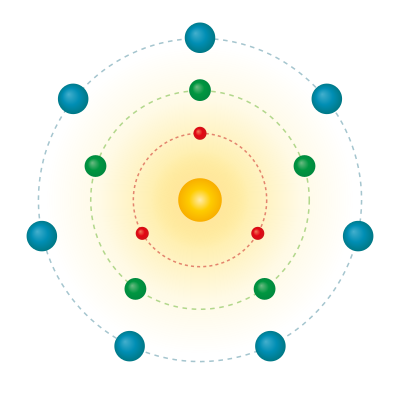
Threshold gamma_p = 1/2
Illustrates the active/inactive cutoff on 3,5,7 then 11,13,17.
View script
idle
PT mathematics / thresholds
Why $\gamma_p$ measures channel sensitivity and selects active channels.
An anomalous dimension is not a hidden spatial dimension. It is a sensitivity exponent: it says how fast a channel reacts when depth changes.
If that sensitivity stays above the $1/2$ threshold, the channel can carry an active direction. If it falls below the threshold, the channel becomes an echo.
PT reads prime channels through a function $\gamma_p$. The primes $3,5,7$ remain active; from $11$ onward, the contribution falls to the inactive side.
This gives a compact mathematical explanation for why some structures close at three active directions rather than infinitely many.
In the monograph, the threshold $\gamma_p=1/2$ is tied to the per-channel GFT condition and to the fundamental symmetry $s=1/2$.
The precise status depends on the level: the definition is mathematical, while the physical identification of active channels belongs to the associated bridges and derivations.
Monograph: ch06_holonomy, ch08_fixed_point, ch23_audit.
The links below point to public resources or planned GitHub repositories. No local working path is exposed to the reader.
Illustrates the active/inactive cutoff on 3,5,7 then 11,13,17.