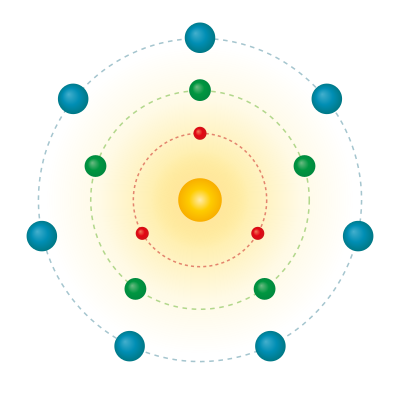
Survivors modulo 30
Computes the surviving residues modulo 2·3·5 and their circular gaps.
Expected: survivors = [1, 7, 11, 13, 17, 19, 23, 29]
View script
idle
PT mathematics / persistence
How a continuous mechanics of constraints makes remarkable persistence points appear.
PT does not start from isolated points. It starts from a field of possibilities, then asks what remains recognizable when constraints act.
A survivor is a point that still carries a distinction after filtering. This is the intuitive meaning of persistence: a form becomes mathematically meaningful when it resists dissipation.
In the sieve, survivors are residues that fall into no eliminated channel. In a probability law, survivors are regions where the distribution remains distinguishable from uniformity.
The general mechanics is therefore: continuous space of possibilities, constraint, entropic loss, then persistence points. Primes, gaps, cyclic phases, and active channels are special cases of the same reading.
Technically, PT reads a survivor as a point where the GFT budget is not entirely dissipated into $H(P)$, but keeps a $D_{KL}(P\|U_m)$ component.
The discrete layer is not introduced as the first ontology: it is the place where the continuum has stationary points, thresholds, or invariant residues under admissible constraints.
Monograph: ch01_sieve, ch04_gft, ch24_scope.
The links below point to public resources or planned GitHub repositories. No local working path is exposed to the reader.
Computes the surviving residues modulo 2·3·5 and their circular gaps.
Expected: survivors = [1, 7, 11, 13, 17, 19, 23, 29]