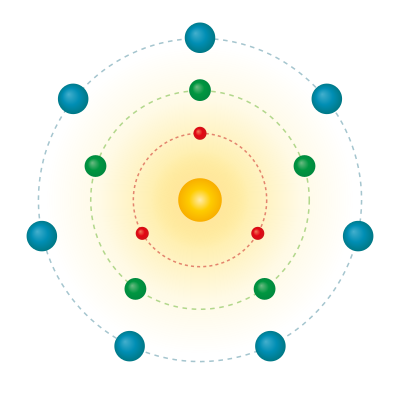
Discrete residue, continuous phase
Turns Z/pZ channels into continuous angular phases.
View script
idle
PT mathematics / dissolution
Why PT does not simply say that the continuum emerges from the discrete.
The correct reading is subtle: in PT, the discrete layer is not the raw material from which the continuum is made. The discrete layer is where a continuous mechanics marks persistent points.
It is like a standing wave: the wave is continuous, yet some nodes or antinodes become remarkable. Those points are not added to the wave; they are revealed by it.
The sieve gives discrete residues, but phases, angles, Fisher metrics, and anomalous dimensions are continuous objects.
PT therefore dissolves the boundary: it does not choose between discrete and continuous; it shows how discrete points are persistence points of a continuous mechanics.
The monograph formulates this passage through CRT, cyclic phase, Fisher geometry, and metric limit. The discrete structure $\mathbb{Z}/p\mathbb{Z}$ already has continuous characters through Pontryagin duality.
The careful statement is: PT gives a co-description where the discrete layer is the remarkable spectrum of the constrained continuum, not a crude approximation to it.
Monograph: preface, ch05_geometry, ch06_holonomy, ch13_relativity, ch24_scope.
The links below point to public resources or planned GitHub repositories. No local working path is exposed to the reader.
Turns Z/pZ channels into continuous angular phases.