Irreducible prime channels
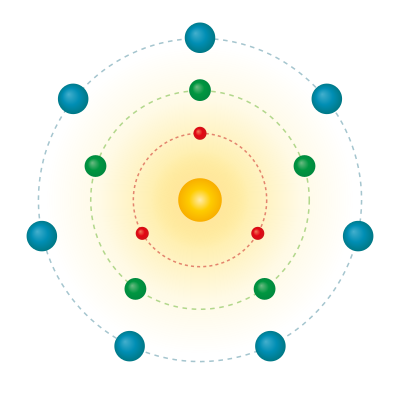
Shows that residues modulo 30 factor into the 2, 3, and 5 channels.
View script
idle
PT mathematics / irreducibility
Why primes appear as irreducible channels of persistence.
In PT, a prime is a discrete resonance point of the sieve: it indexes a persistence mode. The cyclic phase associated with that prime gives an amplitude, and that amplitude determines its status: active, boundary, echo, or super-echo.
Prime numbers are the multiplicative building blocks of the integers. In PT, this is not only arithmetic: it is a channel property.
A composite number mixes several constraints. A prime carries an irreducible constraint: it opens its own cycle, which nothing smaller can factor.
The sieve removes multiples of a channel $p$. If $p$ is composite, that channel is already explained by smaller channels. Only a prime adds a new independent obstruction.
PT therefore reads primes as elementary directions of multiplicative persistence: each $p$ introduces an irreducible cyclic torus $\mathbb{Z}/p\mathbb{Z}$.
The Chinese Remainder Theorem factorizes $\mathbb{Z}/m\mathbb{Z}$ into primary components when the factors are coprime. This makes primes structural, not decorative.
In PT, primes are the minimal cyclic-phase channels compatible with CRT decomposition and GFT conservation.
Monograph: ch01_sieve, ch05_geometry, ch06_holonomy.
The links below point to public resources or planned GitHub repositories. No local working path is exposed to the reader.
Shows that residues modulo 30 factor into the 2, 3, and 5 channels.