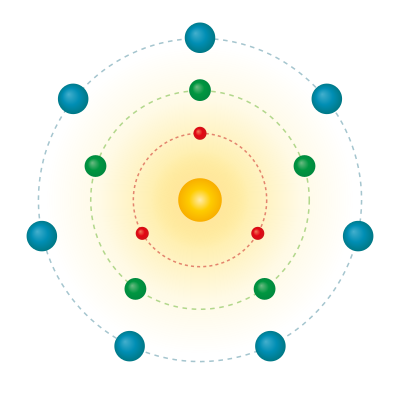
What is hierarchical
The timeline does not date physical instants. It orders prime thresholds: each step adds a capacity for distinction in an instantaneous cascade.
Cosmogony
In PT, the Big Bang is not an explosion inside an already-given time. It is the first stable boundary of the primordial cascade: all steps are cosmologically instantaneous, then p = 2 crystallises as the spin/parity boundary from which the discrete and continuous regimes can separate.
Plain language
Read this page as a structural cosmogony, not as an ordinary chronological story. PT does not begin with a universe already placed inside external time; it first describes a cascade of distinctions that orders itself before measurable time can be read.
The difficulty is not to confuse four objects: the prime 2, the raw sum 17, the physical attractor 15, and time. 2 is not simply “removed”: it changes status. It stops being a dynamic direction and becomes the boundary that makes two branches distinguishable.
The rest of the page unfolds that idea: 3, 5, and 7 form the active core; 11, 13 and then 17, 19, 23 become echoes; and μ* = 15 is the stabilisation point where observables can begin to have physical support.
The timeline does not date physical instants. It orders prime thresholds: each step adds a capacity for distinction in an instantaneous cascade.
2 is not removed. It moves from a term in the raw sum to a separation condition, like a membrane making even/odd readable.
15 = 3 + 5 + 7 keeps the three active directions. It is the arithmetic attractor of the reduced sector where readable time can carry observables.
Standard
At the standard level, “instantaneous” means outside ordinary cosmological duration. The thresholds 1, 2, 3, 5, and 7 are not successive moments like seconds on a clock; they are logical conditions becoming available in the cascade.
As long as the cascade has not produced an oriented signature, measurable physical time is not yet present. There is dependency order, but not yet a time coordinate on which events can be placed.
Time appears when orientation becomes stable: after the boundary carried by 2, and just before the active core 3 + 5 + 7 closes on μ* = 15. In this reading, time is not the initial container of the Big Bang; it is an internal consequence of the cascade.
This changes how the timeline should be read: it is not a sequence of instants, but the list of minimal conditions that make a clock possible. The diagram below only fixes dependency order: boundary, signature, then measurable time.
Plain language
The timeline does not describe a duration. It unfolds a hierarchy: first a neutral support, then a first separation, then the thresholds that actually carry the cascade. Each card answers the question: “what does this prime make possible?”
The primordial cascade does not unfold abstract numbers, but thresholds of persistence. The primes 2, 3, 5, 7, then 11, 13 and 17, 19, 23 mark the discrete points where sieve modes acquire a status: origin, boundary, active directions, echoes, super-echoes.
1 is not a dynamics; it is the neutral reading point. 2 crystallises separation. The primes 3, 5, and 7 give the three active directions. Then 11 and 13 do not restart a new Big Bang: they appear as echoes, measurable traces below the active threshold.
This representation avoids a common misunderstanding: the cascade is instantaneous in the primordial sense. The timeline is pedagogical, not chronological. It shows the logical order through which a structure becomes readable before it becomes a temporal history.
No split yet: the logical support is present, but no parity and no cascade.
originThe p=2 layer separates even/odd. In the 17 → 15 passage, it exits the sum and becomes the spin/parity membrane.
spin / boundaryFirst non-trivial transfer: the antidiagonal imposes alternation and stabilises s=1/2.
cascade startsp=5 completes the 3-5-7 core and acts as a pivot in several signatures, including 42 = 210/5.
pivotWith 3,5,7 the cascade prepares its closure: three active directions, then temporal signature becomes readable.
before μ* = 15Below γ < 1/2: no longer active faces, but visible perturbative corrections.
below thresholdThe line continues as late corrections: super-echoes retain a sieve trace without becoming the main cascade again.
correctionsp=29 acts as the pedagogical bound: the current reading stops here by non-repetition rather than adding a new face.
excludedPlain language
At the plain-language level, the simplest image is a primordial sorting. Before the theory can distinguish physical regimes, everything is still in a raw sum: 2 + 3 + 5 + 7 = 17. 2 is present, and very important, but it has not yet found its final role.
Crystallisation means that 2 leaves the list of active directions. It becomes the first stable cut: even/odd, left/right, spin/parity, discrete/continuous. This is not a disappearance; it is a promotion. 2 stops being a brick counted with the others and becomes the membrane that lets them separate.
Once that boundary is in place, the dynamic core becomes readable: 3, 5, and 7 remain as active directions and close on 15. This 17 to 15 passage is what the page calls “Big Bang” in the PT sense: not an explosion in an already given space, but the appearance of a first stable boundary.
Before crystallisation
After crystallisation
Standard
The wording “fixed point” remains exact for T5: the active sum 3 + 5 + 7 closes on 15. But for cosmogony it is clearer to add that 15 also acts as a physical attractor.
This means that 15 is not just an isolated value. The reduced basin around it slides toward that closure: 13, 14, 16, and 17 return toward 15, and 17 becomes exactly 15 when 2 crystallises.
The monograph, however, places μ = 18 at the first threshold outside the basin: 11 then begins to activate. The page therefore shows it as an exit boundary, not as a new physical closure competing with μ* = 15.
Graphically, 15 is the place where the cascade stops being a raw sum and becomes a structure able to carry observables.
T5/N4 reading: 17 is the last raw fixed point; crystallising p=2 gives 17−2=15 and places the cascade in the attractive basin. μ = 18 is the first integer outside the basin: 11 activates and the iteration no longer returns to a finite closure.
Standard
The timeline becomes more convincing once each prime is given its own status. PT does not merely say “primes appear in order”: it distinguishes thresholds that open a capacity, thresholds that carry the dynamics, and thresholds that only leave a trace.
2 acts as the spin/parity boundary. The primes 3, 5, and 7 form the active core: they remain above threshold and close μ* = 15. From 11 onward, no new active Big Bang face is created in the PT reading; one enters echoes and super-echoes that correct, dress, or prolong the sieve trace.
Standard
The standard level explains why this reading is not merely narrative. The computation does not say “forget 2”. It shows the opposite: p = 2 is the most active prime at the γ > 1/2 threshold, but also the only degenerate one: T₂ = (1).
That combination forces a special status. If 2 is counted as an ordinary dynamic face, one obtains the raw sum 17. If its degeneracy is recognised, 2 becomes a boundary condition and the physical dynamics reduces to the triplet 3, 5, 7.
The 17 → 15 reduction is therefore not an arbitrary deletion. It expresses the status change of 2: first active in the raw cascade, then crystallised as the infrastructure of separation.
The red line is s = 1/2. p = 2 is above it, but it is not a cascade face: it becomes the spin/parity infrastructure.
Technical
The technical level is not an alternative illustration of the Big Bang. It asks which computations force this reading, and which computations degrade if the order or status of the thresholds is changed.
Four constraints meet here: N4 isolates the special status of 2; T5 selects the attractive closure μ* = 15; the γ > 1/2 threshold separates active primes from echoes; and ablation checks verify that the q⁺/q⁻ branches are not interchangeable.
In other words, the page is not offering a free metaphor. It gives a cosmological reading of a chain already constrained by sieve arithmetic, the 17 → 15 reduction, and the discrete/continuous separation.
It carries the spin/parity involution, but T₂ = (1) does not yet give a non-trivial cyclic transition.
The stable physical sum is μ* = 3 + 5 + 7 = 15. It is a fixed point arithmetically and an attractor in the reduced basin; the raw sum 17 slides into it when 2 crystallises.
At μ* = 15, the only dynamic primes above threshold are 3, 5, 7; 11 is already below threshold.
q⁺ carries discrete cardinality; q⁻ carries continuous dispersion. Swapping branches degrades the computations.
Standard
At the advanced standard level, the crystallisation of 2 prepares the q⁺/q⁻ fork. Before μ* = 15, parity is a seed: one knows there is an involution, but not yet two separated physical regimes.
The attractive point 15 gives the resolution. q⁺ inherits the discrete side: cardinalities, vertices, couplings. q⁻ opens the continuous channel: dispersion, propagators, geometry. The bifurcation therefore does not appear ex nihilo; it promotes the parity seed into two computable channels.
That is why the branches are not interchangeable. Ablation checks show that computations degrade if their roles are swapped: the separation carries physical information, not just notation.
Standard
The standard Big Bang describes the hot evolution very well once the cosmological regime is installed. PT does not try to replace that phenomenology: it enters upstream, at the boundary-condition level that the standard model often has to assume.
The question then becomes: why these initial conditions, why homogeneity, why near-flatness, why an entropic arrow? The PT answer is structural: these features are not added as initial tunings; they emerge from the pre-temporal cascade, the crystallisation of 2, and the attractive closure on 15.
Technical
If the branches are swapped in the α computation, the result collapses. The two branches are not just narrative decoration.
Technical
The withdrawal of p = 2 leaves a trace in the bare coupling scale: 1/α(17) − 1/α(15) ≈ 42.
Status
The 17 → 15 mechanism belongs to the T5/N4 sector reduction. The cosmological “Big Bang” reading is structural: it says how PT reads the appearance of a boundary and a dynamics, not that it directly measured a primordial temperature.
Scope of this page
This page stops at the transition from the primordial cascade to the reduced attractor μ* = 15. Observable parameters of the late universe — expansion, dark sector, H₀, neutrinos and observational tests — are handled on the Cosmology page.
Common misreadings
Before going further, it helps to defuse four intuitive but mistaken readings of the PT cosmogony.
Avoid
The Big Bang is an explosion in space.
PT reading
In PT, the Big Bang is the logical order in which channels open. Space itself only becomes legible at p = 7 activation. Before that, there is no "where" to explode.
Avoid
Time existed before the cascade.
PT reading
g₀₀ < 0 (Lorentzian signature) only appears for μ > μ_c ≈ 6.97 — i.e. after p = 7 activates. Before that, the signature stays Euclidean: no proper time, no "before".
Avoid
μ* = 15 was chosen to reproduce physics.
PT reading
μ* = 15 is the physical attractor of the reduced sector of the γ_p > 1/2 iteration, after p=2 crystallises. The basin of attraction is [12, 17]; outside it, divergence or collapse. The value 15 was not adjusted.
Avoid
PT replaces the ΛCDM Big Bang model.
PT reading
PT gives a cosmogonic boundary condition and some strong late-time outputs (H₀, dark sector, n_s), but late cosmology keeps distinct statuses: derivation, physical bridge, validation, or open programme depending on the case.
Numerical landmarks
The stability of μ* = 15 does not rest on a fit. It rests on the geometry of the basin of attraction of the iteration $\mu_{k+1} = \sum \{p : \gamma_p(\mu_k) > 1/2\}$. Any perturbation outside [12, 17] leaves the stable phase. Here are the exact margins ensuring attraction of the reduced sector.
| Quantity | Value | Source |
|---|---|---|
| μ_c (Hartle-Hawking transition) | ≈ 6.97 | g₀₀ changes sign |
| Basin of attraction of μ* | [12, 17] | Iteration γ_p > 1/2 (T5) |
| Divergence if μ ≥ 18 | γ_11(18) = 0.500 | p=11 activation, infinite cascade |
| Collapse if μ ≤ 11 | γ_3(3) = 0.224 | p=3 deactivation |
| p=11 margin at μ*=15 | Δ = 0.074 (15 %) | γ_11(15) = 0.426 |
| p=13 margin at μ*=15 | Δ = 0.144 (29 %) | γ_13(15) = 0.356 |
Informational reading
The GFT theorem partitions a total informational budget between two poles: what is structured (persistent information) and what stays dispersed (entropy). In physics, these two poles have a name:
The primordial universe — hot, dominated by radiation — sits near the maximal entropy pole. As it cools, the GFT cursor moves: light gives way to matter, information concentrates into stable structures. Expansion does not create new information — it reorganises the partition between the two poles, at constant total budget.
This reading clarifies a counter-intuitive fact: light is not the opposite of darkness. The opposite of darkness (total absence of signal) is the presence of information. The opposite of light (information evenly dispersed) is matter (information concentrated). Light and matter are two faces of the same conserved budget.
Going further
The Hartle-Hawking transition at μ_c ≈ 6.97 makes the Lorentzian signature appear.
Late cosmologyHow the cascade freezes into ΛCDM observables with no continuously fitted parameter.
Theorem T5Rigorous proof: closure of the {3,5,7} sector after crystallisation of 2.
Plain essayWhy the sieve splits into two branches after μ* = 15.
Plain essayWhat do {11, 13} do once they are no longer active? They dress α_EM.
CalculatorWatch the basin of attraction take shape as you slide μ.