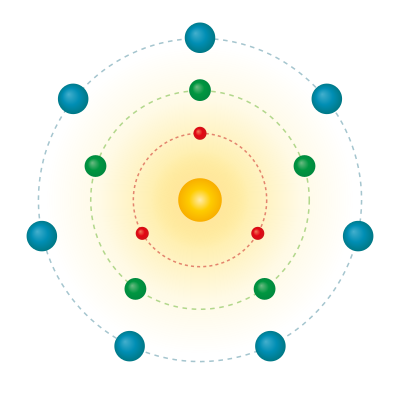
Why three fermion generations?
We observe three families of quarks and leptons, not two, not four. The Standard Model takes that 3 as given. PT derives it.
Go deeper: T5
The observation
The Standard Model contains three fermion generations:
| Generation | Quarks | Leptons |
|---|---|---|
| 1 | u, d | e, |
| 2 | c, s | , |
| 3 | t, b | , |
The symmetry is exact: every generation has the same gauge structure, the same charge, the same content. Only masses change.
Why three? Not two, not four? LEP experiments at CERN measured the decay width and found a number of light neutrinos consistent with 3.000 ± 0.008. Not 2, not 4. Precisely 3.
The Standard Model takes this number as given and says nothing about it.
The PT answer
The number of generations equals the number of active primes at the physical attractor of the reduced sector . That number is 3, and only 3 in this information sector:
The argument is short:
- A prime is active if (BA4 criterion, applied to the derived threshold ).
- At the reduced attractor : , , , , …
- Three are above threshold. The fourth (and all subsequent) are below.
- The cascade stops at . No fourth generation possible.
This is what the monograph calls the “finiteness theorem”: the number of active primes is bounded by the monotone decay of in .
The same structure for
The same logic gives three quark colors: . Three active primes, three directions in SU(3) color space. That is why in PT — they are the same quantity, counted along the lepton or color axis.
This coincidence is not accidental in the Standard Model either: it is what makes the theory anomaly-free (gauge anomalies of leptons and quarks exactly cancel when ). But the Standard Model does not say why this common number is 3.
PT gives the cause: this number is .
A simple prediction
If a fourth generation of light leptons were discovered (a new neutrino with ), PT would be wrong. The cascade could not resume at without breaking the reduced-attractor self-consistency.
This is P12 in the list of falsifiable predictions: exactly. No PT mechanism can accommodate a fourth light neutrino.
The decisive experiments: LEP, Planck (via ), DUNE (precision oscillations). The number holds to better than a percent. As long as it holds, PT survives.
Why it matters
This 3 is probably the most accessible PT result. It can be tested without extreme precision: a fourth family of charged fermions would be directly visible. Fifty years of experiments say it does not exist.
The Standard Model accommodates this fact. PT derives it. That is the difference between describing the world and understanding it: in one case the 3 is an input, in the other it is a consequence of the sieve of Eratosthenes.