Sieve dynamics
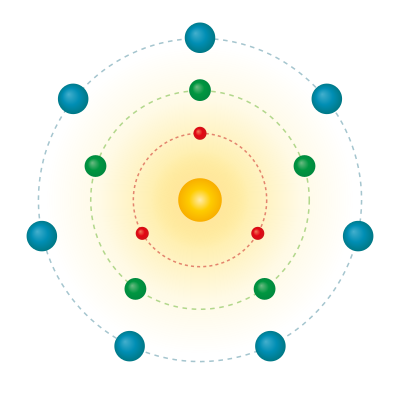
Tracks survivor density as the 2, 3, 5, and 7 constraints are added.
View script
idle
PT mathematics / filtration
Reading the sieve not as a mere algorithm, but as a filtration dynamics.
The sieve of Eratosthenes looks like a method for crossing out multiples. In PT, it becomes a minimal laboratory: a constraint acts, one part disappears, another persists.
This matters because a theory of persistence needs a simple object where one can see the difference between noise, loss, residue, and structure.
Each new prime modifies the survivor space. Density falls, gaps recombine, but the remaining residues keep a transportable structure.
The sieve is therefore the discrete reading of a continuous mechanics under constraint: apply a constraint, see which traces remain stable, repeat.
The exact dynamics is written through a Legendre/Buchstab-type recurrence: $\Phi(x,a)=\Phi(x,a-1)-\Phi(\lfloor x/p_a\rfloor,a-1)$.
PT adds the informational reading: each step redistributes the budget between entropy and persistence in the GFT sense.
Monograph: ch01_sieve, ch07_convergence.
The links below point to public resources or planned GitHub repositories. No local working path is exposed to the reader.
Tracks survivor density as the 2, 3, 5, and 7 constraints are added.