Cyclic phase
Computes delta_p and sin^2(theta_p) for a few prime channels.
View script
idle
PT mathematics / phase
How CRT and cyclic phase force channel products.
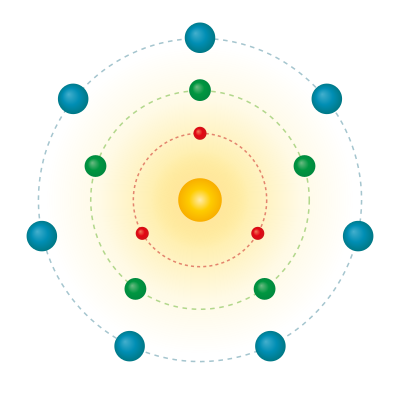
When several independent cycles coexist, each can be read separately and then recomposed. This is the intuition behind the Chinese Remainder Theorem.
PT adds that each cycle carries a phase. A persistent channel is not only an open slot: it is a stable cyclic orientation.
CRT decomposes a composite module into coprime prime channels. Pontryagin duality turns this decomposition into a product of characters.
This mechanism makes PT product forms natural, especially in bridges where the active channels $3,5,7$ contribute multiplicatively.
Cyclic phase is encoded by $\theta_p$ with $\sin^2\theta_p=\delta_p(2-\delta_p)$. It turns channel depth into persistent amplitude.
The monograph treats the BA5 product form as locked by CRT + Pontryagin under the relevant bridge axioms.
Monograph: ch05_geometry, ch06_holonomy, ch09_bridge, BA5.
The links below point to public resources or planned GitHub repositories. No local working path is exposed to the reader.
Computes delta_p and sin^2(theta_p) for a few prime channels.