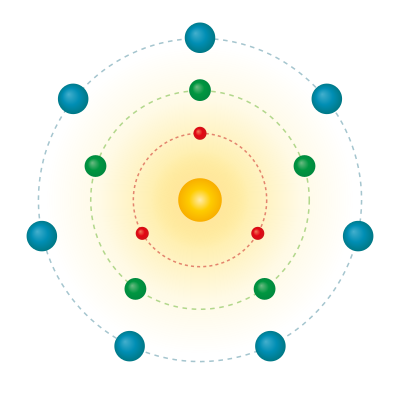
Survivor gaps
Reproduces the 6,4,2,4,2,4,6,2 gaps of the sieve modulo 30.
Expected: gaps = [6, 4, 2, 4, 2, 4, 6, 2]
View script
idle
PT mathematics / sieve
Reading prime gaps as a limiting case of gaps between sieve survivors.
A prime gap is the distance between two neighboring primes. PT starts more simply: a gap is the distance between two positions that survived the sieve.
When the sieve depth reaches the square-root window, the remaining survivors are exactly 1 and the primes. Prime gaps become a survivor-mechanics problem.
Modulo a primorial $M_A$, residues coprime to $M_A$ form a circular sequence. Successive differences give the sieve gaps.
Exact reduction to primes occurs at $y=\lfloor\sqrt{x}\rfloor$: every composite $n\le x$ has a prime factor $\le\sqrt{x}$ and cannot survive.
The exact core is $S(x;\lfloor\sqrt{x}\rfloor)=1+\pi(x)-\pi(\lfloor\sqrt{x}\rfloor)$, where $S(x;y)$ counts integers divisible by no prime $\le y$.
The open part is not the reduction to primes, but the fine closed law that would predict each gap $p_{n+1}-p_n$ without already knowing the neighboring primes.
Monograph: ch01_sieve, ch07_convergence, Riemann part.
The links below point to public resources or planned GitHub repositories. No local working path is exposed to the reader.
Reproduces the 6,4,2,4,2,4,6,2 gaps of the sieve modulo 30.
Expected: gaps = [6, 4, 2, 4, 2, 4, 6, 2]