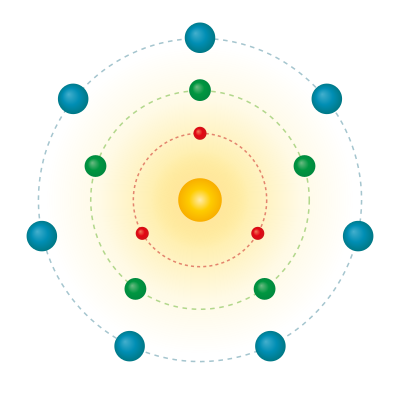
Light prime spiral
Produces coordinates for a few prime points on an Archimedean spiral.
View script
idle
PT mathematics / visualization
Using Ulam, Sacks, or Archimedean spirals as visualizations of prime survivors.
Prime spirals make something surprising visible: primes do not look like uniform noise.
PT can use them as a pedagogical showcase: when the sieve acts, survivors keep alignments, bands, and geometric traces.
A spiral does not prove a law. It turns an arithmetic sequence into an image and reveals correlations the eye grasps quickly.
For the mathematics section, it is an excellent plain-language bridge: one sees before calculating why survivors have geometry.
The PT_SPIRALS project can provide figures comparing Ulam, Sacks, and Archimedean spirals, with checks by modular classes.
The status should remain visual and exploratory unless a precise modular statistic is computed and referenced.
GitHub repository to publish: Igrekess/PT_SPIRALS; monograph ch01_sieve.
The links below point to public resources or planned GitHub repositories. No local working path is exposed to the reader.
GitHub repository to publish before this can become a download link.
Produces coordinates for a few prime points on an Archimedean spiral.