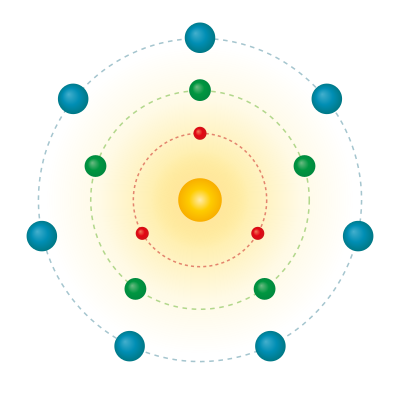
N_gen
Formula
$$N_{\rm gen} = |\{p \text{ actif à } \mu^*\}| = |\{3,5,7\}| = 3$$
Input theorems
This derivation uses the following theorems from the PT chain:
Derivation
N_gen — number of fermion generations
$N_{\rm gen} = 3$: three fermion generations (e/μ/τ and u/c/t and d/s/b and $\nu_e$/$\nu_\mu$/$\nu_\tau$). In PT, a theorem:
$$ N_{\rm gen} = |\{p : \gamma_p(\mu^*) > 1/2\}| = |\{3, 5, 7\}| = 3. $$
Why exactly 3?
Same argument as $N_c = 3$ (ID 40): at $\mu^* = 15$, active primes are {3, 5, 7}. No others. T5 proves this by exhaustive rational scan.
The coincidence $N_{\rm gen} = N_c$ makes the Standard Model gauge-anomaly-free. Required for quantum consistency.
Epistemic status
Exact. Not a measurement, not a probabilistic prediction. Unconditional theorem: $|\{3, 5, 7\}| = 3$ by enumeration.
Indirect test
LEP measured the number of light neutrinos via $Z^0$ width: $N_\nu = 3.000 \pm 0.008$. If a 4th generation of light neutrinos ($m < m_Z/2$) were discovered, PT would fall. This is P12 in the list of falsifiable predictions.
See also essay [Why three fermion generations?](/en/essays/why-3-generations).
See also
- All 43 observables
- PT calculators — γ_p, sin²θ_p, α_EM live
- Full monograph
- Verification scripts