Being and having, addition and multiplication
The being / having dyad is more than a metaphor: it is inscribed in arithmetic itself. Additive position vs multiplicative factorisation, and PT as a cosmology of the passage between the two.
A simple question, on the surface
You are someone. And you have a name, a job, people you love, perhaps a cat. When you say “I am”, you speak of yourself as a person. When you say “I have”, you speak of what comes with you, of what makes you up.
The distinction sounds trivial. It isn’t. It runs through Western philosophy — Marcel, Heidegger, Sartre wrote books on it. Are we our possessions, or merely someone who carries them? Am I my body, or do I have a body?
Here is the surprising idea: this same tension between being and having is inscribed, almost word for word, in something as cold and unexpected as arithmetic. And that is exactly where Persistence Theory finds its logic.
Counting is just taking a place
When you count — one, two, three, four, five — each number names a position. “Five” is the fifth box in the sequence, the fifth rung on the ladder, the fifth day. Nothing more.
If I just say “five” to you, you can’t tell how we got there. Four + one? Three + two? It doesn’t matter. The number is its place in the sequence, and it does not remember the path you took to reach it.
That is what five is. Its place. Nothing behind it to reconstitute.
But a number also has ingredients
Now consider twelve. It is at a place too — the twelfth. But it has another life: it can be broken down. Twelve is two times six. Or three times four. Or six times two.
If you push that breakdown all the way to numbers that can no longer be divided, you get what you could call the recipe for twelve: two × two × three. Like a cookbook saying: “to make twelve, you need two ingredients of type 2 and one ingredient of type 3.”
Those are the ingredients of the number. What it has.
Prime numbers: the ingredients that won’t divide
All numbers can be broken down into smaller ingredients in this way — except one particular family: the prime numbers. 2, 3, 5, 7, 11, 13, 17, 19, 23, and so on, forever.
A prime number is one you can’t split into equal parts (other than parts of a single element). Seven tables don’t arrange into two equal rows, nor into three, nor into four. One single block, irreducible.
These numbers are the ultimate ingredients of arithmetic. All the others are built out of them. And there is a remarkable result, proved two thousand years ago in Euclid’s Elements: every number has one and only one recipe. Twelve is always two × two × three. Never anything else.
The place where being and having merge
Let’s recap. Most numbers lead a double life: their place in the sequence, and their recipe of ingredients. For twelve, those two things are distinct. The place “twelve” and the recipe “two × two × three” both refer to the same number, but they are not the same object — a result on one side, its constituents on the other.
Except, as it turns out, when you take a prime number. Seven, for instance: its place in the sequence is the seventh. Its recipe of ingredients is seven. Itself. Nothing else.
For a prime number, its place and its ingredients are literally the same thing. There is no longer anything to tease apart between them. The result is the recipe.
This is the only case, among all the integers, where what a thing is and what a thing has coincide exactly. That is what makes prime numbers strange, and that is what gives them, in a certain mathematical literature, a special status — that of fixed points of a movement that everywhere else keeps being and having apart.
The link with Persistence Theory
Persistence Theory begins with a question: when a system passes through a constraint, what disperses, what remains?
The theory observes that what remains — what does not dissolve into the noise — is structurally similar to these prime numbers. They are the indivisible structures, in a precise sense: those where what one is and what one has end up coinciding. Everything else — composite structures, which are only an assembly of decomposable parts — disperses at the slightest filter.
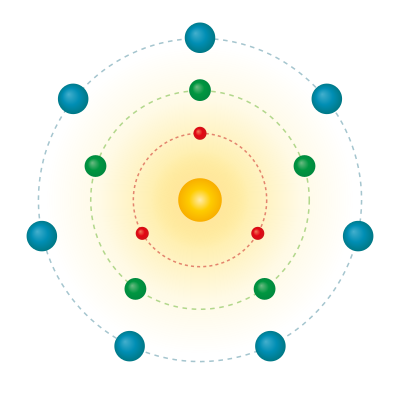
Six prime numbers play a particular role in this theory: 2, 3, 5, 7, 11, and 13. Why these six? Simply because they are the first primes — the ones at the top of the list. And each subsequent prime carries less weight than the one before it: their influence shrinks as p grows. Beyond 13, that weight becomes small enough that, to a good approximation, you can ignore it. These six are, in the theory’s language, the skeleton of everything observable.
A picture to take away
Next time you buy a dozen eggs or count the steps on a staircase, you can keep this image in mind: every number has two faces. Its place, and its recipe.
For most, those two faces are distinct. But a few — the prime numbers — have only one. There, being and having become indistinguishable. And it is perhaps for that reason that we find them, deep down, in everything that lasts.
The gesture
Marcel said all of philosophy might fit into one question: am I my body, or do I have a body? Heidegger restated it his way, Sartre his. A very old dyad runs through Western thought, and that is the one: being and having.
The aphorism that opens PT — everything says what it is by revealing what it no longer has — turns on the same gap. Presence shows itself through dispossession.
What I find interesting is that this pair isn’t only a philosophical figure. It’s inscribed, more or less word for word, in arithmetic.
The integer as additive position
Our first relation to integers is positional. 1, 2, 3, 4… To count is to juxtapose units. An integer is its place in the sequence, nothing more. No internal relation, no decomposition. It is there, at position n.
This is additive arithmetic: Σ ℤ, succession, quantified duration. The integer as pure being. 7 is the seventh position, full stop.
Addition has no memory: given 7, you can’t tell whether you got there through 3 + 4, 2 + 5, or 1 + 6. No decomposition is privileged. That lack of memory is precisely what makes it the image of pure being — the position is there, with nothing behind it to reconstitute.
The integer as multiplicative factorisation
But 12 isn’t only the twelfth position. It is also 2 × 2 × 3, a thing that has two 2s and one 3. Multiplication reveals a within : parts, an internal structure.
This is multiplicative arithmetic: Π primes, factorisation, possession. The integer as having.
Like addition, multiplication also erases the path: 12 doesn’t say whether you got there through 4 × 3 or 6 × 2. But unlike addition, it leaves behind a canonical decomposition: 12 is 2² × 3, and that’s it. That uniqueness is what changes everything.
The fundamental theorem of arithmetic
Here is the pivot — a theorem inherited from Euclid (book VII of the Elements) and given its modern form by Gauss: every integer greater than 1 has one and only one decomposition into a product of primes, up to ordering.
In other words: every being (every additive position) reveals a unique having (its factorisation). That uniqueness is what reconciles the two regimes — without it they would stay disjoint.
The opening aphorism, in arithmetic notation:
Everything says what it is (its additive position) by revealing what it no longer has (its deferred factorisation — what was dispersed into factors).
The aphorism is a literary gloss of the theorem, or the theorem is the technical translation of the aphorism. Either reading holds.
Primes as fixed points
That leaves the prime numbers, and this is where the picture closes on itself.
A prime p has only one possible factorisation: itself. Its additive position and its multiplicative content are the same thing. For a prime, being and having identify with each other. The fold of this tension turns inward and shuts.
Primes are the only integers where this happens. Atoms of the multiplicative: it is that very indecomposability that makes their position and their factorisation collapse into one — nothing left to factor beyond themselves.
Hence, I think, their particular status in PT: what persists under the sieve are the positions where being doesn’t reduce to an external having. Where the thing is, with nothing left over, what it has.
PT as cosmology of this tension
The cascade s = 1/2 → {2, 3, 5, 7, 11, 13} reads then as a journey through the cone of uncertainty between addition and multiplication. At each step of the sieve a decision plays out. What reduces to a pure product survives. What is only an additive succession — a composite number, possessing factors other than itself — disperses.
All prime numbers, in fact, are positions where additive being and multiplicative having coincide — the property does not single out the first six among them. What PT adds is a selection criterion. In the sieve dynamics each prime channel carries a weight γ_p that decreases rapidly with p; the six first primes — 2, 3, 5, 7, 11, 13 — are simply those whose amplitude remains large enough to structure what we observe. Beyond 13 that weight becomes small enough that the cascade ignores them to a good approximation, around the reduced attractor μ* = 15. Other primes still exist; they are neutralised by their low amplitude.
A signature
So arithmetic thinks ontology, and the other way round. The same structure, read at two different levels.
When you read reality exists in the cone of uncertainty between addition and multiplication, you also read reality exists in the tension between being and having. The two sentences are equivalent — not by analogy, by translation. Both describe what can, on passing through the filter, persist without being lost.