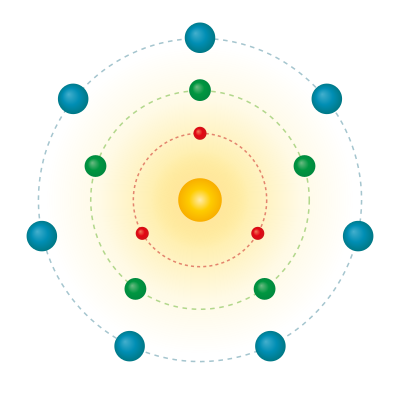
Persistence Theory through geometry
A pedagogical reading of the PT chain: the sieve as a filter, primes as resonance points, and geometric form as the carrier of space, time, and observables.
From filter to form
Persistence Theory (PT) can be read as a geometry of filtering. It does not start from a pre-existing space, nor from a time that is already unfolding. It starts from an elementary constraint: the Eratosthenes sieve, understood as a dynamics in which addition scans the integers and multiplication removes the composites.
In this reading, prime numbers are not only arithmetic objects. In PT, a prime is a discrete resonance point of the sieve: it indexes a mode of persistence. The cyclic phase associated with that prime gives an amplitude, and that amplitude determines its status: boundary, active mode, echo, or super-echo.
The shortest formula is:
What remains is form.
But “form” must be understood strongly. Form is not decoration: it is the structure made visible by constraint. It measures what passes through the filter without losing its structural identity.
Seeing the chain
Imagine an infinite road lined with lamps: the integers.
At first, every lamp is lit. The sieve passes like a sequence of filters: it turns off multiples of 2, then of 3, then of 5, then of 7. The lamps that remain lit are the survivors. But the important point is not only which lamps remain. It is also how the road darkens, where the lights thin out, and which rhythms appear between the lamps that are still on.
The sieve acts on this line. It removes composites, keeps survivors, and leaves a trace in the gaps between survivors. PT therefore does not only look at the list of primes. It also reads what filtering has inscribed in gap distributions, modular cycles, amplitudes, and status changes.
The primordial cascade does not unfold abstract numbers, but thresholds of persistence. The primes 2, 3, 5, 7, then 11, 13 and 17, 19, 23 mark the discrete points where the sieve modes take on a status: origin, boundary, active directions, echoes, super-echoes.
This is not an ordinary cosmological chronology. The steps are instantaneous in the primordial sense: they form a logical hierarchy before measurable time can be read.
To understand the discrete/continuous relation, think of a standing wave. The nodes are discrete, but the wave is continuous. The nodes do not manufacture the wave; they mark the places where it holds. In PT, primes play this role: they are the points where the sieve wave becomes stable and readable.
To understand Z/pZ, imagine a clock with p positions. The integer line keeps
moving forward, but its signature returns cyclically on the dial. The modular
circle is not an external picture: it shows how the line already carries a
phase.
To understand q⁺ / q⁻, imagine a stained-glass window. Seen from the front, we
measure how much light passes through each color: this is the vertex reading,
the reading of couplings. Followed along the lead joints, we measure how the
pieces connect: this is the edge reading, the reading of propagation. The window
does not split into two objects; it receives two readings.
To understand Fisher, imagine a map reconstructed without knowing the territory. If two neighborhoods give almost the same paths, the map places them close together. If a small displacement strongly changes the observed paths, the map separates them. Fisher turns informational distinguishability into geometric distance.
Finally, time is not the road itself. A map can tell us where to go, but it does not yet give us a clock. When one direction on the map receives the opposite sign from the others, it stops being read as “more space”: it becomes the rule that orders possible changes.
Discrete and continuous: two faces of one object
The most delicate point is the relation between discrete and continuous.
PT does not say: “first the discrete, then the continuous.” Nor does it say: “the continuous replaces the discrete.” It says instead that the same arithmetic object has two inseparable faces.
The discrete is the readable face: primes, thresholds, orbits, cardinalities, statuses. These are the points where a wave of persistence becomes stable, nameable, and computable.
The continuous is the background face: phases, amplitudes, Fisher metric, scale
parameter μ, holonomies, curvature. It is not added after the fact. It is already
inscribed in the discrete structure, because the finite circles Z/pZ, their
Pontryagin characters, and their cyclic phases already carry the geometry of
S¹.
In PT, primes play this role: they are the stable points of a continuous mechanics of phase and filtering. The discrete is the persistent marking of the continuous, and the continuous is the internal geometry of the discrete.
The geometric gestures of the chain
The PT progression can be summarized as a sequence of geometric gestures:
| Gesture | Object | PT reading |
|---|---|---|
| Distinguish | threshold | s = 1/2, invariant from mod-3 alternation |
| Separate | boundary | p = 2, parity, spin, bifurcation membrane |
| Filter | line | integers, sieve, survivors, prime gaps |
| Wrap | circle | projections Z/pZ, cyclic phases, holonomy |
| Stabilize | attractor | μ* = 15 = 3 + 5 + 7, closure of the active core |
| Deploy | space | three active directions carried by 3, 5, 7 |
| Sign | time | metric direction with opposite sign |
| Measure | observables | constants, masses, angles, chemistry, cosmology |
This table is not a proof. It is a reading map. It helps avoid mixing levels: the threshold, the boundary, the active modes, the echoes, and the observables do not play the same role.
The threshold s = 1/2
The first invariant of the chain is:
s = 1/2It comes from the dynamics modulo 3. In the active residue classes, admissible
transitions impose an alternation: the stable structure is symmetric between the
two residual branches. The stationarity of this alternation gives the threshold
1/2.
This threshold is not a tuned parameter. It then acts as a status criterion: a mode above the threshold can become active; a mode below it becomes an echo, correction, or late trace.
The special role of 2
The prime 2 is deeper than an ordinary dynamical direction.
It crystallizes the first separation: even/odd, parity, spin, boundary. In the raw sum, one can read:
2 + 3 + 5 + 7 = 17But after crystallization, 2 changes status. It is not simply removed; it
becomes the membrane of separation from which the two readings of the dynamics
can be distinguished.
The physical closure is then read on the active core:
3 + 5 + 7 = 15The passage from 17 to 15 does not mean that 2 has been forgotten. It
means that 2 leaves the dynamical sum and becomes the boundary that makes the
bifurcation possible.
The line: survivors and gaps
Mathematically, persistence is read in the Eratosthenes sieve: the primes are the irreducible survivors of the additive-multiplicative coupling, where the multiplicative constraint removes composites while the additive progression reveals the dynamic trace of the survivors through prime gaps.
These gaps are not statistical decoration. They are the trace of filtering. Part of the information disperses into entropy; another part remains structured.
The central informational formula organizes this split:
Hmax = D_KL + HHmax is total capacity, H is entropic dispersion, and D_KL is persistent
structure. PT reads observables as measures of this distribution between
dispersion and structure.
The circle: wrapping the line
Projecting modulo p means wrapping the line of integers onto a finite circle:
Z → Z/pZIf all positions on the circle are visited uniformly, nothing persists. If some positions are favored, forbidden, or phase-shifted, a structure becomes visible.
Each prime therefore defines a discrete circle, but this discrete circle already
carries a continuous phase. Fourier characters on Z/pZ are not a decorative
analogy: they are the natural way to read phase on that circle.
The holonomy identity summarizes the passage:
sin²(θp) = δp(2 - δp)It turns an arithmetic deviation into a geometric amplitude. This is where a prime becomes a mode of persistence.
The three active modes: 3, 5, 7
At the reduced attractor, the three active primes are:
3, 5, 7They form the physical core of the cascade:
| Prime | PT status | Geometric reading |
|---|---|---|
3 | first active mode | alternation, T3 matrix, invariant s = 1/2 |
5 | central pivot | indetermination, median channel, stabilization |
7 | active closure | third direction, preparation of space |
The triplet does not mean only “three numbers.” It means three modes above the threshold, three active directions, three factors of geometry.
Space is therefore not posited as a container. It is the continuous reading of the active triplet.
Echoes and super-echoes
Beyond 7, primes do not disappear. They change status:
11, 13       → echoes
17, 19, 23   → super-echoes
29+          → non-repetition boundary
Echoes do not launch a second main cascade. They keep a trace of the sieve below the active threshold. They can enter as corrections, late signatures, or secondary structures, but they do not carry the fundamental directions.
This distinction matters: all primes count, but they do not all play the same physical role.
μ* = 15: reduced attractor
The central closure of the chain is:
μ* = 15 = 3 + 5 + 7One can call it a self-consistency point, because the active set closes on its own sum. But the more precise reading is that of a reduced attractor: the dynamics slides toward the configuration where the active modes recognized by the threshold themselves form the stabilizing value.
The short chain is:
s = 1/2      → threshold
2            → boundary
3, 5, 7      → active modes
15           → reduced attractor
15 is therefore not decorative. It is the point where the cascade becomes
stable enough to carry observables.
The q⁺ / q⁻ bifurcation
The bifurcation is read as:
q⁺ = 1 - 2/μ
q⁻ = exp(-1/μ)
This duality should not be understood as “discrete versus continuous.” Both
branches act on the same prime substrate {3,5,7}, and both carry a discrete
face and a continuous face.
q⁺ is the vertex reading: it inherits more directly from cardinality, orbits,
localized interactions, and couplings.
q⁻ is the edge reading: it follows propagation, dispersion, metric, transport,
and extended geometry.
The bifurcation does not create two worlds. It gives two readings of the same object: vertex and edge, interaction and propagation, particle and wave.
Schematically:
{1 ↔ 2} mod 3
      ↓
s = 1/2
      ↓ lift to μ*
q⁺ = 1 - 2/μ        q⁻ = exp(-1/μ)
vertex / local      edge / propagation
The 2 gives the seed of separation. μ* = 15 gives the two computable
branches.
Space: three active circles
Each active prime can be read as a circle, or as a cyclic mode. The three active modes therefore give a structure of the form:
S¹ × S¹ × S¹The associated physical reading is an anisotropic Bianchi I geometry: three
directions, three scale factors, three weights inherited from 3, 5, 7.
The Fisher metric plays a central role here. It measures distinguishability between internal states: two states are close if many observations are needed to distinguish them, and far apart if a small change strongly modifies the distribution. Geometry is therefore not imported as a background; it is the natural rule of distance imposed by the statistical structure of the sieve.
Time: a signature, not a container
PT does not place the cascade inside a pre-given time.
Time appears when the informational geometry receives a direction whose sign is opposite to the spatial directions. Technically, this is read in the sign of the metric component:
g00(μ) = - d² ln(αEM) / dμ²The sign change occurs around:
μc ≈ 6.97and the reduced attractor μ* = 15 already lies in the Lorentzian regime.
In simple language: as long as geometry carries only internal distances, there is no proper duration yet. When one direction receives the opposite sign from the spatial directions, that distance is no longer read as a length, but as a duration.
Time is therefore not the stage of the Big Bang. It is an internal consequence of the cascade.
Observables and statuses
From this chain, PT announces 43 observables: coupling constants, masses, mixing angles, chemical quantities, and cosmological extensions.
The important pedagogical rule is to separate statuses:
| Status | Meaning |
|---|---|
| Theorem | internal mathematical result |
| Identity | algebraic or informational equality |
| Bridge | identification between a PT structure and a physical object |
| Physical derivation | calculation following from bridges |
| Validation | numerical comparison with measurement |
| Prediction | value proposed before independent test |
| Open | speculative or incomplete point |
This separation protects the theory from two symmetric mistakes: reducing it to a vague intuition, or presenting all its extensions as equally demonstrated. The strength of the site is precisely to make levels of proof visible.
What this reading clarifies
The geometric reading reformulates several difficult questions:
- Why three active dimensions? Because
3, 5, 7are the three modes above the threshold. - Why does
2return everywhere? Because it becomes boundary, parity, spin, and bifurcation condition. - Why is time different from space? Because it is not an additional active circle; it is a metric signature coming from depth.
- Why do later primes still matter? Because they become echoes and super-echoes.
- Why can observables be calculated? Because the amplitudes associated with sieve modes give geometric ratios, couplings, and corrections.
Synthetic formula
PT through geometry can be stated this way:
The sieve filters the line of integers.
Survivors carry a trace.
Primes index the resonance points of that trace.
2crystallizes the boundary.
3, 5, 7form the three active directions.
15stabilizes the structure as a reduced attractor.
The continuous, space, and time are geometric readings of this form.
Or:
The discrete marks the places where the wave holds.
The continuous is the wave made readable by those places.
Limits
This reading is pedagogical. It does not replace the demonstrations in the monograph, nor the verification scripts.
Technical markers
The compact formulations to check in the monograph are:
Hmax = D_KL + H
q⁺(μ) = 1 - 2/μ
q⁻(μ) = exp(-1/μ)
μ* = 15 = 3 + 5 + 7
g00(μ) = - d² ln(αEM) / dμ²
The status separation remains decisive: s = 1/2, the holonomy identity, and
the closure of the active sector belong to the internal mathematical chain;
physical observables then pass through bridges, physical derivations,
validations, and predictions.