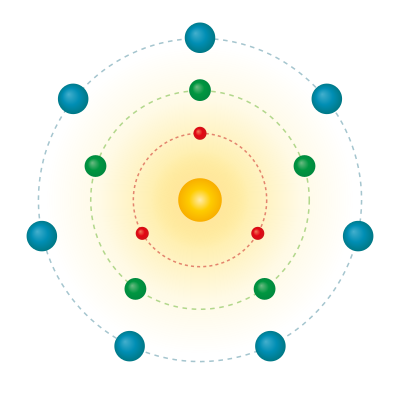
CRT — Sieve decoupling and causal invariance
The sieve factors additively: $\mathbb{Z}/P \cong \bigoplus_p \mathbb{Z}/p$. Operations at different primes commute.
Statement
Let be a square-free modulus. The Chinese remainder theorem (CRT) gives the ring isomorphism
Let denote the sieve projection removing the class . Then projections at distinct primes commute:
The order in which primes are removed affects neither the survivor set, nor the gap statistics, nor the transfer matrix.
ThéorèmeWhy it matters
CRT decoupling is the structural gauge invariance of PT. It plays several converging roles:
- Locality of the sieve. Sieving at prime acts only on the factor ; other factors are invariant. This is the exact arithmetic analogue of spatial locality.
- BA5 product form. Combined with Pontryagin duality (characters of direct sums are multiplicative products), it forces the product form of the gauge coupling.
- Causal invariance. Permutation of the active primes same final set, same observables. This is the discrete arithmetic analogue of general covariance (Wolfram, Gorard).
- KL uniqueness (G1) and Fisher product structure inherit directly from this decomposition.
Without CRT, neither the product form nor gauge invariance would be forced: they would have to be postulated.
Proof — outline
Step 1. CRT is a classical theorem of ring theory: , is a ring isomorphism whenever the are pairwise coprime.
Step 2. The projection removes exactly of the elements uniformly in each class (). Hence and act on disjoint factors and commute.
Step 3. All observables (, , , ) depend only on the final survivor set and the gap structure — not on removal order. They are therefore -invariant.
Statistical independence of components (to leading order in ) follows from the prime number theorem for arithmetic progressions.
See also
- BA5 — Pontryagin product — product form of the coupling
- G1 — Uniqueness of — uses CRT for additivity
- T2 — Spectral conservation — uses the factorisation
- All theorems