Primes are the waves that persist
Each integer is a discrete wave on the circles Z/pZ. The primes are the self-coherent superpositions that survive the sieve’s interference. An intuitive reading of BA5, T1 and L0 — with a guard-rail against a common mistake.
The picture in one sentence
If we treat each integer as a discrete wave on the circles , then the primes are the only superpositions that survive the sieve’s interference. Everything else — the composites — cancels by destructive phase.
This picture is not a poetic metaphor. It is what three canonical PT theorems, read together, actually say.
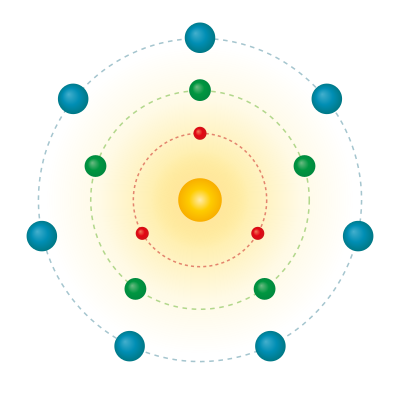
Three circles, positions each
The space of residues modulo is literally a discrete circle of points:
- = triangle (3 positions)
- = pentagon (5 positions)
- = heptagon (7 positions)
The Chinese Remainder Theorem (CRT) gives a tensor product factorisation:
Every integer lives in this space through its residue signature . That is its wave signature.
Why primes persist: three theorems read together
T1 — Forbidden transitions. The transitions and mod 3 are structurally forbidden between consecutive primes beyond 3. Not by an ad hoc rule: by arithmetic cancellation. Three integers in arithmetic progression in the same class modulo 3 must contain a multiple of 3 — a composite. This is pure destructive interference, written in the transfer matrix , whose structural zeros are the phases that cannot survive.
L0 — Maximal distribution. Under the constraint of fixed mean gap, the geometric distribution is the unique maximum-entropy distribution. In other words: the amplitude that the prime gaps actually take is the largest one possible consistent with the constraint. The primes are not one fluctuation among many — they sit at the maximum intensity allowed by their own statistics.
BA5 — Pontryagin product. The fine-structure constant reads:
and this is, algebraically, a product of Fourier characters on . The theory does not identify with something that resembles harmonic analysis: is an object of harmonic analysis on the discrete circles. What PT computes is the resonance between three waves of 3, 5 and 7 points.
Read together, these three theorems say: the Eratosthenes sieve is the unique evolution operator whose eigenmodes are the primes (naturalness theorem N2: ). Every non-prime is a superposition that fails self-coherence: it destroys itself. Every prime is a superposition that reproduces itself.
The trap to avoid: size is not strength
The wave picture sometimes suggests that the larger the circle, the more information it carries, hence the stronger it is. This is wrong for coupling strength. Here are the canonical values at :
The anomalous dimension — which measures how strongly channel contributes to physics — decreases strictly with . The smaller circle gives the strongest coupling. The correct intuition is the opposite of the naive one: fewer positions on the circle = more holonomy accumulated per turn.
Essential distinction: cardinality is extensive (number of positions on the circle); strength is intensive (coupling per position). Confusing the two inverts the channel ordering and makes it look as though should dominate.
This is also why the sieve stops at : from onward, , and the wave is no longer intense enough to open a physical channel. It remains as an echo — that is the informational dark matter (see the related essay).
In one sentence
Primes are the eigenmodes of the sieve: the only discrete waves whose superposition is self-coherent under filtering. What PT calls «persistence» is, at the root, the survival of certain frequencies through Eratosthenes’ interference — with a strength that decreases, not increases, with the size of the circle.
See also
- What is persistence? — the operational definition
- What is an echo prime? — what happens beyond
- Where does come from? — the Pontryagin product in detail
- Theorem T1 — Forbidden transitions
- Theorem T6 — Holonomy identity
- Axiom BA5 — Pontryagin product