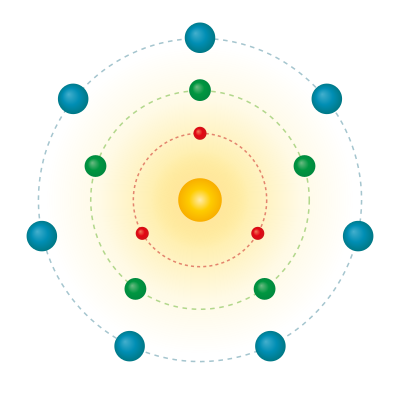
Active prime criterion
A prime $p$ is active iff $\gamma_p > s = 1/2$ — the active set is exactly $\{3,5,7\}$.
Statement
At the reduced attractor , a prime is called active if and only if its anomalous dimension satisfies
The active prime set is exactly . The exact rational formula is
ThéorèmeWhy it matters
The criterion is the filter that selects the three primes physically relevant to the Standard Model. It simultaneously delivers:
- the number of colours ( theorem, ch. 8),
- the number of generations (via Fisher–Koide),
- the fixed point (T5),
- the product form of the coupling (BA5).
Without the active prime criterion, there would be no canonical discrimination between primes — and so no reason for the physical observables to organise around exactly three channels.
Proof — outline
(i) Exact rational computation (fractions.Fraction) at
:
The first three values are strictly , the last two strictly . The boundary falls between and .
(ii) Analytic monotonicity argument for : write where is exponentially decreasing (factor ) dominating the polynomial growth of . Hence for every .
(iii) Robustness: any threshold yields the same active set. The physics is structurally stable under ±17 % variation of the threshold.
Full details: monograph §6.6, file
PT.Holonomy.ActivePrimeAnalyticMonotonicity.
See also
- T6 — Holonomy — formula
- T5 — Attractor —
- — colour from the sieve
- BA5 — Pontryagin product — product over the active primes
- All theorems