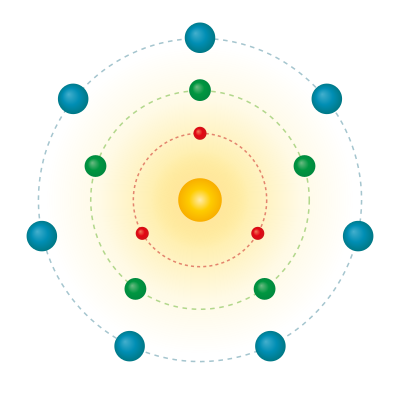
$N_c = 3$ — Colour from the sieve
$N_c = N_{\text{spatial}} = 3$: unique integer solution of $(N_c+1)!/(N_c+3) = 2^{N_{\text{spatial}}-1}$.
Statement
The colour number and the spatial dimension are the unique positive integer simultaneously satisfying the spatial dimension equation:
The unique integer solution is .
ThéorèmeWhy it matters
This is one of the most striking PT results: the colour number of QCD and the spatial dimension of our universe are jointly forced by a single elementary arithmetic equation, with no adjusted parameter.
The theorem is purely arithmetic. Its physical interpretation ( colours, dimensions) is a BRIDGE identification — but the combinatorial uniqueness itself is a THM.
Combined with the active prime criterion (, hence ) and the generation
count (theorem
N_gen_from_active_spectrum), PT delivers the triad
from the single fixed point .
Proof — outline
Direct enumeration:
| power of 2? | ||
|---|---|---|
| 1 | no (non-integer) | |
| 2 | no (non-integer) | |
| 3 | yes → | |
| 4 | no (non-integer) | |
| 5–20 | various | none is both integer AND power of 2 |
For , is neither an integer nor a power of 2 — verified exhaustively by enumeration up to , then closed off by factorial growth dominating the polynomial decay of the denominator.
The unique pair survives.
See also
- Active prime criterion — where “3” primes come from
- T5 — Attractor —
- T6 — Holonomy — phases over the 3 active primes
- All theorems